skip to main |
skip to sidebar
Note: I referred several times in this blog post to the idea of entropy "increasing forever", when of course it does no such thing. What I meant to refer to was an inflationary cosmology. I knew I would get some technical details wrong, and worse yet, my other fear -- that this post is redundant -- also seems to be true as well: Carroll tackles a similar scenario just a few pages later in Eternity than where I was when I wrote this. Still, there is some difference: Carroll is arguing that a non-inflationary universe is in contradiction with our observations; whereas I am pointing out that even if, in a misguided attempt to salvage the universe from a future of eternal emptiness, we invoke the anthropic principle to wave away the problematic observations, the universe we find ourselves in is far worse than one which ends with eternal emptiness. Carroll is saying, "This can't be true," while I am saying, "Even though we might fool ourselves into thinking otherwise, we really don't even want this to be true."
Well lookie here, Sean Carroll noticed my preliminary comments about From Eternity to Here, and he blogged about it. I am frankly honored, a bit star-struck even -- though if I'd known this would happen I wish I had put more time into that post! Sean's response in a nutshell seems to be, "Maybe it's a fair cop, but it's difficult to see any way to do better." I think I agree with that. I still think that a reader for whom this book is her first exposure to relativity and quantum mechanics (and logarithms, yeesh) is not going to follow a lot of it... but a lot of the review material is welcome anyway. Good popular science writing is immensely difficult, and Eternity is a truly stellar example of it. I really can't recommend this book enough!
I'm still not quite to the end of the book (I'm a little over 75% of the way through), so perhaps my thinking in this post is wrong-headed, or possibly redundant... but in any case, I think this book has incidentally given me a somewhat more positive view of the heat death of the universe.
Let's face it, the idea that the universe will end not with a bang, not even with a whimper, but with a gradual diffusion into a sea of unstructured particles is downright depressing. Making it worse is the idea of proton decay, a concept that was introduced to me by the light and fun book Death from the Skies. ("Don't be a dick", Phil? Maybe you could start by not telling me the most fucking depressing fact in all of cosmology... dick!)
But I am beginning to think that, if we really take seriously the conclusions of entropy and statistical dynamics, a universe in which we did not expect the arrow of time to point monotonically and irrevocably from the Big Bang towards heat death is even worse.
I am thinking back to what Sean Carroll refers to as the "Boltzmann-Lucretius scenario" (naming it jointly after the brilliant physicist and the renowned poet and philosopher, as each suggested a similar idea about infinite random recurrences of the universe). In this scenario, the universe as we know it, with it's apparent low entropy state, is the result of a random fluctuation from a high entropy state in an eternal universe. The Poincaré recurrence theorem implies that, in an eternal universe of flat spacetime, it is not just possible but inevitable that every possible state will eventually be arrived at by random chance -- including the exact state of the universe in which we find ourselves right now.
Carroll handily disposes of this idea, pointing out that there are all sorts of features we would expect to see in such a random fluctuation which we do not in fact see in our universe; and that, conversely, the features we do see are far more consistent with the idea of our universe having evolved from a low entropy boundary condition.
But hold on there for a moment, let's not just leave it at that. Let's say we have indeed convinced ourselves that the Big Bang really was a low entropy boundary condition, and that this explains the arrow of time (what Carroll calls "the Past Hypothesis"). Yet, having accepted that conclusion -- and therefore having at least nominally disposed of the Boltzmann-Lucretius scenario -- now let's also say that, since we find the idea of the universe dissipating into a uniform quantum soup to be distasteful, we've convinced ourselves that we ain't going out like that. We started out from a low entropy boundary condition called the Big Bang, which defines the arrow of time for us, but we'll eventually settle into a flat universe, where, although the average entropy remains constant, "stuff can still happen". The alternative is too depressing, right?
The second part of that hypothesis may be just wishful thinking, but even still, we ought to be careful what we wish for... because if I'm not mistaken, the consequences of such a universe are epistemologically devastating. Our dear frenemy Poincaré (don't be a dick, Poincaré!) has proven that, even if we accept that there was at one point a nice orderly universe which evolved naturally from a low entropy boundary condition to a state of high entropy, if we don't allow the entropy to keep increasing indefinitely then there would then follow an infinite series of universes that only seemed to have started from a low entropy boundary condition, but really they were merely random departures from equilibrium.
Even if we believed there had been one very nice existentially satisfying Big Bang-bounded universe, the most parsimonious explanation for our current situation would be Last Thursdayism. Sure, it looks like we are living in that very special and orderly "first universe" possessing a nice clear arrow of time leading from a low entropy big bang to a high entropy "future"... but it's far more likely we are in reality in one of the infinite number of "later" universes which happened to randomly fluctuate into a state that just sort of "looked like" it came from a Big Bang.
Except it's even worse than that. Since, in such a universe, all history is an illusion, there is no way to lean on inductive reasoning in order to predict what will happen at any other moment in time. In such a reality, the most parsimonious explanation for the sensations we are experiencing at any given instant in our lives is that we came into being only a picosecond "ago" due to a random fluctuation of the eternal equilibrium end state of the universe, and we will cease to exist a picosecond "later". Sure, we might be in one of the many universes which are evolving from a random low entropy fluctuation that occurred Last Thursday, putting us in a state that approximated a particular Thursday in the "first universe"; but it's inconceivably more likely that we are in a much more local deviation that simply created the illusion of all of that for one infinitesimal moment. It is a nigh certainty that nothing you see is real; with overwhelming probability, you are nothing more than a Boltzmann brain that perceived for an instant the illusion of being in that special "first universe", and then evaporated an instant later.
So yeah, the fact that an expanding universe allows entropy to increase indefinitely sounds depressing... maybe it is a bit depressing... but the alternative is far, far worse. In a universe that will at some point reach a state of eternal thermal equilibrium, with the accompanying random fluctuations into low entropy states, nothing is knowable, nothing can be believed. The heat death of the universe makes me sad, but if it weren't inevitable then the only logically defensible world view would be nihilism.
I am currently reading From Eternity to Here by Sean Carroll. Excellent stuff; although I'm only a little less than halfway through, I think I can say with confidence that if I were to write a review, it would be a very positive one.
But one small complaint is I'm not sure if he's quite exactly worked out his audience. Early in the book, I was starting to fear it would be a rehash of stuff I already knew. It's not. But there were some elementary rehashes that, frankly, I think if someone went into the book not having that knowledge already, they aren't going to be able to grok the rest. This is not a mathematically demanding book, but it is a conceptually demanding book, and I am not sure if someone who doesn't have some limited grounding in the mathematics side will be able to make it through the conceptual side without missing a lot.
Carroll spends a good chapter or two explaining the rudiments of general relativity. At one point, he expends a few paragraphs for the benefit of people who don't know what a logarithm is. And then on page 176, he tosses this out:
Boltzmann has told us a compelling story about why entropy increases: There are more ways to be high entropy than low entropy, so most microstates in a low-entropy macrostate will evolve toward higher-entropy macrostates. But that argument makes no reference to the direction of time. Following that logic, most microstates within some macrostate will increase in entropy toward the future but will also have evolved from a higher-entropy condition in the past.
Emphasis is mine. Now, Carroll has been hinting at this for dozens of pages, and I've been anticipating it... but it's also been kinda bending my mind. Perhaps I am being a bit elitist, but I don't see someone who does not already have a deep gut feeling for mathematics understanding the profundity of that statement.
Now, I'm not saying I think someone needs to be an expert in general relativity, or a pro at computing logarithms, to understand this book. The treatment Carroll gives them is quite sufficient for his aims. Nevertheless, there is a certain math-y way of thinking which Carroll seems to take for granted, and I am skeptical that there are many people out there who are able to follow along with that assumed paradigm and yet who don't already know (at least conceptually) what a logarithm is.
It's not like the simpler material is entirely unwelcome: For me personally, I can always use a review of the rudiments of general relativity, as it's a concept my educational background unfortunately has given me very little time to explore. I can't exactly call curved spacetime "old hack", y'know? I'm just sorta wondering, does Carroll really think that someone who doesn't already have a firm grounding in basic math and physics is going to follow along with some of his more esoteric philosophical explorations of the nature of entropy? I'm skeptical.
I encountered this brain-teaser on another blog quite some time ago -- wish I could say which one, but I no longer recall -- and it turns out to be harder to articulate the answer than one might think. I puzzled through it at the time, and then I remembered it again last night and had to re-figure it. Thought I might record my thoughts on it this time around.
One reason I don't remember the original blogger is that he or she simply left it at, "Nobody can really quite say!", which is simply not true: it's just very difficult to say it, but one can indeed figure it out. Try it yourself before you read on, if only to realize that it's not as trivial as one might expect!
Perhaps unsurprisingly, 95% of the answer stems directly from how left and right are defined, and if you want to skip to that, click here. Before that, however, I think it's useful to consider some directions which are not reversed in counter-intuitive ways.
Imagine a woman facing north and looking dead-on into a mirror at eye-level. She is wearing a ring on her "left" finger -- but this is the last time I will use the words "left" and "right" until we come to the answer, so let's say instead that she is wearing a ring on her west finger. Her eyes are facing north, as previously stated, and her head is pointing up.
For the woman in the mirror, all three axes -- north/south, east/west, up/down -- behave exactly as expected for a reflection in the plane of the mirror. Mirror woman's ring is still on her west finger, her head is still pointing up, but now her eyes are facing south. No surprises here, right?
This is because north, south, east, west, up, and down all have definitions which can be expressed independent of both a) any other direction, and b) the content of what you see. (There's actually a couple different ways of thinking about this for up/down, but for an earthbound mirror at eye-level the ambiguities don't come into play, so let's ignore them for now.) The compass points are defined by the Earth's magnetic field -- or by geographical convention if you prefer, but the result is the same -- and up and down are defined in relation to Earth's gravitational field. (Probably.)
In contrast, left and right are not well-behaved in this way; they are defined in relation to two other directions, namely top and front. Uh oh, and there's two new directions, "front" and "top". These are not well-behaved either; they are defined in relation to the content of the scene. For now, however, I am going to treat "top" as synonymous with "up", for simplicity, and then re-examine that assumption later. So when you add it all up:
"Left" is defined as the cross-product of "up/top" and "front", while "front" is defined by visual cues within the scene, such as the direction a person's eyes are pointing. (I think I got my signs right there, but don't beat me up if the correct cross-product is the other way; you get my point!) In our example of a woman facing north straight-on into a mirror, "up" stays constant, because it is (probably) defined in relation to gravity, while "front" reverses compass directions. The real woman's front is north, while the mirror woman's front is south -- we know this because "front" is defined in this case by the side of her body where her eyes are.
Interestingly, if one could make one's brain do the mental contortions, it ought to be possible to visualize it so that the woman's front and back have been reversed, i.e. that her eyes are now on the "back" of her head, her toes point "backwards", her back is now on her "front", etc., and if you could do that, then I believe one would also see that her left/right have not been reversed. The ass-backwards mirror woman still has her ring on her left hand. However, I find this impossible to fully conceptualize; I get about halfway and my mental image ends up looking like the teleporter scene from Spaceballs. It's worth trying this exercise anyway, if only because it helps illuminate why it is so difficult to articulate the answer to the titular question of this blog post. Our assumptions about the definition of left/right and front/back are so ingrained that even when we name the assumptions and express a conscious intention to discard them, we are still stuck with them. We can't help it.
Now imagine the woman turns 90-degrees to her left, so that she is facing west (but the mirror is still north of her). This is actually an easier case. Now we see that front and back are still the same -- west and east respectively -- but left and right have been reversed because they are directly perpendicular to the plane of reflection. It's no surprise that left and right are reversed in this case; how could they not be!
The math gets slightly more complicated if the woman is facing into the mirror at an angle (but still at eye-level, for now), but it ends up working out the same. In these scenarios, rather than one relevant axis staying the same and the other being reversed, both axes are partially transformed. It all works out though: Left/right will be transformed directly by reflection over the plane of the mirror, and indirectly via the same transform of front/back, and together it winds up with left/right being completely reversed.
I've been hand-waving so far on up/down and top/bottom, because they are the same as long as the mirror is at eye level. But what if the mirror is directly above the woman's head, and she is looking straight up at it? This case works out as well, although now it is important the we distinguish "top" as being something defined by the content of the scene, and we will also see that the definition of "up" is a bit slippery and people might have different ways of looking at it -- especially once you moved away from the Earth into space!
I also want to look at some cases where maybe left and right are not reversed in a mirror, because there are no cues to give you front/back or top/bottom. Alas, my sons really need some attention right now, so this will all have to wait for a follow-up post.
A lot of people who want to believe the faster-than-light neutrino result (and count me as one who would love it to be true!) are displaying a tendency to get quite pissy at those of us who remain skeptical, e.g. see this comment over at Bad Astronomy, which is actually one of the more mild ones. There are accusations of dogmatism, that a "true" skeptic should just follow the results.
That is true as far as it goes, but in my never-humble opinion, if you want to "follow the results" properly, you must be a Bayesian.
The prior probability, based on everything we know about physics, that neutrinos can travel faster than the speed of light in a vacuum, is vanishingly small. The results of countless past experiments would have to be either dismissed, or given a completely different explanation. Anything is possible, of course, but as somebody else said (can't remember where, sorry, no credit), this is "possible" on the order of saying, "Oops, turns out gravity doesn't attract, it repels!"
And Bayes tells us then, that even what would be very solid experimental support for this result in another context is totally unconvincing in this context. Bayes Theorem doesn't quite work this way, but to just simplify it: Let's say last week I gave you trillion-to-one odds that neutrinos could travel faster than light. Then we come up with an explanation for how this result could be an error, but unfortunately it requires a series of coincidences that are a billion-to-one against. I'd still believe it was the billion-to-one error before I'll believe FTL neutrinos were a real thing.
It's probably something much more mundane, of course. Or perhaps it will turn out to reveal some weird new physics where the neutrinos can appear to some observers to exceeding light speed, but in a way that doesn't screw up causality and relativity; that would be neat. But if you're a Bayesian (and you should be), then you can be virtually certain that it's not really FTL. Sorry, sci-fi fans. No galactic empires for you.
So it appears from several sources that the three most common elements in the universe are, in order, hydrogen, helium, and oxygen.
The first two make perfect sense to me. Hydrogen especially -- it's basically just a stray proton, right? Most of them have an electron buddy, of course, but it's not hard to see how that could happen. And then helium is two protons fused together, and as far as I understand it requires the lowest amount of energy to fuse. So that makes sense. You've got a universe full of stray protons (your most common element) and when they start to clump together producing heat and pressure, you fuse pairs of them together and get your second most common element.
But whence oxygen? It's #8 in the periodic table. My simple-minded imagination would have thought the order of frequency of elements would have been roughly the same as their atomic number, allowing some idiosyncracies for what's more stable, etc. And if it weren't, I would have expected the next most common to be maybe a noble gas, or just generally something with a distinct position in the periodic table. I can't see anything special about oxygen...
I'm assuming it has to do with some idiosyncrasy of stellar evolution. Can anybody help me out here?
A thought occurred to me while commenting over at Jerry Coyne's blog, and I just want to give a more concise version here.
The equations underlying the theory of relativity are quite elegant and beautiful. A friend of mine tells me of a modern physics class he was taking where the students burst into applause when the professor finished the derivation of E=mc2. So much complexity is summed up so simply and in such a cohesive theory.
This suggests that it might be true, but it's not evidence. One of the first solid pieces of evidence in favor of relativity was that it accurately predicted the precession of Mercury. And of course many more observations came later which confirmed the value of Einstein's theory over Newton's. One by one, the skeptics were forced to take Einstein's work seriously.
But let's imagine an alternate reality where relativity hadn't made this prediction, and in fact it's prediction for the orbits of all the other planets was somewhat less accurate than traditional Newtonian dynamics. Would a contemporary skeptic still have to take Einstein seriously? Would Einstein have been justified in saying, "You simply don't understand the math behind it. Look how elegant this equation is! Look how it unifies space and time in such a concise way! If you aren't convinced, I think you really need to read my book..."?
No he would not. And in a world where, it seems to me, the evidence against theism is overwhelming, we are under no compulsion to explore logical arguments for God. Arguments based on pure reason are often useful, but they ultimately carry very little to no evidential weight. I don't need to understand Aquinas' Five Ways in detail, or be able to point out the flaws in them, because I can just look around say, "Welp, no gods here. Must be some flaw in his reasoning or a concealed false assumption or something." Pure reason is valuable, but it has no power to convert the skeptic, nor should it. And that goes whether you are talking about science or theology.
Mortality's been on my mind more lately, for really obvious reasons: A very close family friend died suddenly in December, a former girlfriend of mine died suddenly a few weeks ago, and there has been a spate of two-degrees-of-separation deaths as well, i.e. not people we knew, but people we knew knew. That'll sure make you think about death a lot!
It still doesn't hugely bother me, and I mostly stand by what I wrote about the topic back in January 2010. The thought of oblivion is a little bit more unnerving now that it's more viscerally "real" to me, but not that much more unnerving. What's actually been troubling me more than the idea of my own eventual annihilation has been proton decay and its implications about the fate of the universe. I'm finding the idea that someday every particle in the universe will have disintegrated, even if it's an absolutely inconceivable 1090-odd years in the future, to be really troubling and bleak.
So then this morning on the drive to work I was thinking about cosmic voids (yes, really) and for a moment I had that same feeling of an incomprehensible magnitude of bleak nothingness -- though not quite as powerfully as when contemplating the eventual breakdown of all the protons in the universe. It hit me that, depending upon how we view the relationship between space and time, as well as how much stock we put in the concept of the present, they could be no different!
Nobody really quite knows what to make of time. I tried reading The End of Time by Julian Barbour, which proposes a radical reimagining of how we perceive time in relation to physical reality, but I only made it about 2/3 of the way through before the heady math and geometry was just too much for me. In any case, where I'm leading is that one way of viewing the universe is as a static 4- (or more-) dimensional object. There's no particular present, just points in spacetime. Of course there are many different ideas on how we ought to interpret time in relation to physical reality, but this is one of them, and based on our limited knowledge at this point in history, it could be valid.
If we look at it that way, then there is little practical difference between the incomprehensible emptiness of cosmic voids in the spatial domain vs. the incomprehensible emptiness of a dead universe in the temporal domain. (Depending on the spatial geometry of the universe, there could be one important difference, in that if the universe is finite but unbounded for example, there's no spatial direction you could go in where you would encounter unending emptiness, but there is a temporal direction where you can... but I'm not sure how important this is to my point here.) So when we stare into the temporal abyss, when we contemplate the eternal death of the universe, it ought to be no more existentially disturbing than when we contemplate the spatial abyss of these incomprehensibly large voids.
Which is to say, it's still pretty freakin' disturbing, but perhaps more manageable. Voids are still one of the bleakest things I've ever heard of.
The BBC reports that researchers at the Tevatron particle accelerator in Illinois are claiming the possible discovery of a new high-energy particle not predicted by current formulations of the Standard Model. It's not nearly high enough energy to be the Higgs-Boson, so they are thinking it's something completely unanticipated.
Now I am not a particle physicist, but this smelled fishy to me right off the bat, even before I remembered the whole story with Tevatron. Extraordinary claims, and all that. There are surely many refinements to be made in our understanding of particle physics, and the precise energy of the expected Higgs-Boson particle is of course highly uncertain. But a completely unanticipated particle, that would be... well, highly unanticipated. These things happen, of course, but it would take a lot of convincing, and even the researchers themselves agree they have not met the required uncertainty threshold yet.
But there's more. The BBC was extremely remiss in failing to point out in the article that Tevatron is scheduled to cease operations this September, unless they somehow miraculously secure an extension of their federal funding. The reason given is that it has been "made obsolete" by the Large Hadron Collider. Oh, and lookie, the scientist they quote casting a skeptical eye on this discovery works on the LHC. Hmmmmm, are you thinking what I'm thinking?
Again, I am not a particle physicist, but it seems obvious to me that this is what's going on:
The Tevatron folks are desperate. They feel they can still do useful work (and for what it's worth I agree; see below) and yet the whole project is going to be shut down in less than six months.
Now, the folks at these particle accelerators comb through a lot of data. As a recent XKCD graphically illustrates, the more data you are going through, the higher your chances of false positives. The standard of certainty for these guys isn't p < 0.05, it's p < 0.00001 (I think I counted the right number of zeroes... 5-sigma certainty). Tony Weidberg, the guy from the LHC project, is quoted as saying, "every few years we get these three-sigma [p < 0.001] effects..." (That is the certainty level being claimed by the Tevatron researchers at present.)
So a shade over five months from Doomsday, the Tevatron data fortuitously happens to show one of these three-sigma blips. In a desperate gambit to garner public exposure for the (still very useful!) work they do, they decide to go public with it right away, with breathless claims of a possible new particle. If their plan works, there is an initial spike of popular support for the Tevatron effort, which barely diminishes when (as not reported prominently in the mainstream media) the blip turns out to be nothing. Hell, maybe they can even leverage some of the populist jingoism we are so afflicted with these days -- after all, the LHC is located on the border between France and Switzerland. We can't let those cheese-eating surrender monkeys gain the edge in particle accelerators, can we?! The hope is that they can parlay this into an extension of their funding.
And to be honest, I don't really begrudge the Tevatron researchers for this last ditch maneuver. It is true that the pace of significant discoveries from Tevatron has waned, and it's also true that the LHC is bigger and better in virtually every way. On the other hand, there is only one LHC, so having the lower-energy Tevatron operational means the world's researchers can run twice as many experiments within that energy range. The LHC could be knocked out of commission for a period, by like a catastrophic magnet failure or something -- I know it sounds far-fetched, eh? Moreover, the annual operating budget for Tevatron is $35 million. So dudes, like, take one day off from mixing it up in Iraq, and you can keep Tevatron open for eight more years. (Seriously, fucking do the math, it's that ludicrous!)
Is it ethical? Would I engage in this kind of misrepresentation in their situation? Hell, I dunno. But I sure don't blame 'em. They're getting short shrift here, and if this little PR sleight of hand buys them some more time, more power to 'em.
Edit: Karl Withakay has pointed out a couple of omissions and a small factual error in this post. I have indicated this in the footnotes. Please do read his illuminating comments, especially if you are interested in the more technical aspects of nuclear technology.
The news from the Fukushima Daiichi nuclear plant continues to be horribly depressing. For me, nothing mitigates this kind of discouragement more than being overly technical about it, so let's do that.
As bad as the situation is, there's been lots of really just stupidly over-the-top fear-mongering, and other websites have done a good job addressing that. One thing I've noticed has been omitted, though, is that while there are many resources out there reassuring people that a nuclear explosion is not possible in this case, because a nuclear reactor and a nuclear bomb are two completely different things, I haven't seen anyone offering a lay explanation of why that is the case. So I will attempt to do so here.
Say you've got a lump of Uranium-235, the fuel used in most nuclear reactors. Really, you'd have a lump of rock that contained some amount of U-235, which you would have attempted to purify as much as possible, but this is all beside the point1. This lump of U-235 can be subcritical, critical, or supercritical.
To understand what these terms mean we need to briefly revisit the basics of a nuclear fission reaction. I'll leave the detailed explanation to the Wikipedia article, but for our purposes, the important point is that when a U-235 atom splits into two pieces, along with the energy that is released, it also ejects three stray neutrons. It turns out that what induces the U-235 atom to split in the first place is being struck by a stray neutron. So you fission one atom, which causes three more atoms to split, which in turn trigger nine more fission reactions, then 27, then 81, and so on exponentially until you get a whole heapin' load of energy.
Except not quite. The stray neutrons don't always hit a U-235 atom. Sometimes they miss, and just go shooting off into the distance. Actually, since all the matter around us is mostly empty space, they usually miss.
And here's the key point: The more dense your lump of U-235 is -- the closer together the atoms are -- the more likely it is for an ejected neutron to bump into one of the atoms. I'm sure this makes good intuitive sense, since obviously it's easier to hit one of a whole bunch of targets clustered close together than it is to hit a one of a few targets scattered far apart.
If the odds of a neutron hitting a U-235 atom are less than 1 in 3, i.e. on average, each time an atom splits and ejects three neutrons the average number that go on to trigger another fission reaction is less than one, then we say the mass is subcritical. You will get some energy released, but the reaction will rapidly peter out as you run out of neutrons.
If the odds of a neutron hitting a U-235 atom are exactly 1 in 3, i.e. on average, each time an atom splits and ejects three neutrons an average of one of them connects, then we say the mass is critical. You will get a fairly constant release of energy until all of the fuel is used up. This is how you want to run a nuclear reactor.
If the odds of a neutron hitting a U-235 atom are more than 1 in 3, i.e. on average each split atom causes more than one other atom to split, then your mass is supercritical. All other things being equal (which they aren't; more on this in a second) fission will continue in a chain reaction style, releasing energy faster and faster, until you get a mind-numbingly large explosion.
This is how you want to build your nuclear bomb. But the thing is, just being supercritical isn't enough. Your mass has to be really supercritical to get a bomb of any serious yield. This is because supercriticality tends to be self-limiting. To see why this is, let's examine what (probably) happened with North Korea's unsuccessful atomic bomb test: Fizzle.
The North Korean bomb test managed to create a pretty supercritical mass of U-2352. The chain reaction starts, and, as intended, a really impressive amount of energy is delivered in a really short period of time, causing an explosion. But in that unsuccessful bomb test, the resulting (relatively small) explosion blew the mass of uranium apart before most of the U-235 had a chance to fission. So there was an explosion, but not nearly as big as they were looking for.
It turns out it's really hard to get around this problem. The North Korean engineers had to work pretty damn hard even just to get the result they did. If you tried to just slowly squeeze some U-235 together to make a supercritical mass, you'd never get there, because as soon as you got very slightly supercritical, you'd either burn up enough uranium that you weren't supercritical anymore, or you'd heat it up and the density would go down enough to take you out of the supercritical zone.
And that's what makes it so damn hard to build a nuclear bomb. Your bomb contains some amount of subcritical material, and you need to smash or squeeze it together so that it becomes not just a little supercritical, but hugely amazingly supercritical, and it does it so fast that the bomb doesn't blow itself apart when you are only halfway there. Even successful nuclear bombs of the type described so far have a fairly low percentage yield, which is why engineers have designed all sorts of clever ways to mitigate this problem.
(For a moment, I must digress because I noticed my enthusiasm is showing through here. I find the technology behind nuclear weapons to be absolutely awe-inspiring; it is just such a remarkable feat of pure engineering. But from a human perspective they are also terrible terrible things, and I am confident the world would be better off without them. Just to be clear. My fascination with the technology does not in any way diminish my opposition to the horror that these devices can wreak upon humankind.)
So what does all this have to do with nuclear power plants? Well, as mentioned before, you want the fuel for your nuclear power plant to be right around (actually just under) the critical mass. That means it's not even close to exploding. (The explosions at Fukushima Daiichi were hydrogen combustion explosions, not nuclear explosions, and other blogs have already explained how that happened far better than I ever could)
Even if somehow the fuel got compressed so that it became supercritical, it would rapidly self-correct down to the critical level, by heating, melting, or (if somehow it got really supercritical, which it wouldn't) blowing apart. It's just so damn hard to get uranium to the level where you'd have a legitimate atomic bomb explosion, there's just no way it could possibly happen by accident.
We might have intuitively expected this, since the first artificial nuclear reactor was built by Enrico Fermi and a handful of grad students on a freakin' abandoned tennis court (and in fact it even occurs naturally in at least one place in the world), whereas the first successful nuclear bomb test required scores of the world's top physicists, a massive industrial support operation, and god knows how much money and resources. But it's worth understanding the reasons anyhow.
This doesn't mean that the situation at Fukushima Daiichi couldn't get really bad. The worst case scenario for a nuclear power plant is more akin to a dirty bomb, which is not exactly super happy fun time either. And, I struggle how to say this tactfully, but the real tragedy may be that this torpedoes our last best shot at a politically tenable solution to (at least temporarily) dodge the problem of global warming. It is only a little bit hyperbolic to say that this tsunami may in the end kill billions. More about that in a future post, perhaps.
1Turns out this is not so much "beside the point" as I thought. Karl Withakay tells us that while the fuel used in commercial nuclear reactors is enriched to contain about 3-5% U-235, the minimum purity requirement for a bomb is around 20%, and in practical devices it is much much higher. So not only is it impossible for even highly-enriched uranium to "accidentally" become supercritical enough to create a significant explosion, you couldn't even do it on purpose with the fuel used in nuclear reactors.
2Karl also points out that the North Korean test used plutonium rather than uranium. For the purposes of this explanation, the concept is similar enough to suffice. But please do read Karl's comments, which provide some additional technical background and clarify a few minor errors I made in trying to whip off this post using top-of-my-head knowledge rather than actually doing the research.
Jonah Lehrer is getting a lot of flak from the skeptic community over an article in the New Yorker he wrote about the "decline effect", whereby some statistically significant correlations tend to "wear off" over time as more and more attempts are made to replicate them.
It's an interesting problem, and for the most part he gave a thoughtful examination of the issues and their causes (the primary cause, IMO, being simple publication bias). However, he was harshly criticized -- and rightly so -- for the final paragraph of the original article in which he seems to flirt with a destructive form of post-modernism, a rejection of the very nature of objective fact. The worry is that he has given more fodder for science deniers of all stripes to ignore the overwhelming evidence in favor of evolution, climate change, etc. and against most forms of alternative medicine, psychic ability, etc.
I felt his first follow-up (sorry, I can't find the link at the moment) clarified his position sufficiently, and I sort of think the continued criticism he is receiving is overblown. I do want to highlight one rhetorical question from his most recent follow-up, however, because I think this question is very answerable. The context here is that he is discussing how the theory in evolutionary biology of "fluctuating asymmetry" initially got several false positives in numerous studies, before the preponderance of evidence turned against it.
This raises the obvious problem: If false results can get replicated, then how do we demarcate science from pseudoscience?
In principle, there is a very simple answer to this question, though of course applying it is often quite messy in practice: Bayes' theorem.
I'm a bit too busy at work right now to give even a brief treatment of the Bayesian mode of thought, but the Wikipedia article does a nice job, so read that if you are unfamiliar. As it applies to Lehrer's present question, we can (usually) demarcate science from pseudoscience by taking a guess at the prior probability.
Fluctuating asymmetry falls in the "science" camp, despite the fact that it ultimately turned out to be false, and even despite the fact that it was prematurely elevated to the status of "true" based on an (in retrospect) insufficient number of positive results, because it was a priori plausible. Homeopathy, on the contrary, falls in the "psuedoscience" camp, despite the fact that some trials of homeopathy have achieved positive results, because it is completely implausible.
As I said, this can get messy in practice. How would one classify early trials of acupuncture, when plausibility could be argued either way? And how much undue resistance was there to the theory of continental drift (now solidified in the more complete theory of plate tectonics) because most scientists at the time found the idea of moving continents to be a priori implausible?
But we already knew science is messy, and I think that overall Lehrer's original article and follow-ups have helped illuminate one of those messy aspects to a lay audience. I must reiterate that I agree with those who found the concluding paragraph of the original article to be severely misguided -- and I think in this most recent reply, he also missed an opportunity for a teaching moment by not digging deeper into his self-posed question. The question about demarcation does have an answer, one that is relatively simple in principle, if not in practice.
Bjørn inspires me to answer Michael Egnor's questions. It's actually not a bad summation of the "Big Questions", even though some of the ordering and phrasing is clearly meant to have a polemical element. Still, probably worth each individual going through it.
Before I start, I do have to say that, first, as Bjørn points out, all that is required to be an atheist is a lack of belief in gods. The way Egnor begins his post is analogous to a philately club president asking, "If aphilatelists don't collect stamps, just what the fuck do they collect?" Clearly a dumb question. Even if we are charitable and assume Engor is specifically trying to understand the Gnu Aphilatelists, who have made a lot of press lately opposing the influence of stamp-collecting on public policy, and pointing out rampant examples of misogyny, homophobia, and child abuse that have been regularly occurring at philately clubs... he implies that "[i]f New Atheist belief can only be expressed by negation of the beliefs of others," that this is inherently a bad thing. It's not. If I protest against Canada's sanctioned baby seal harvest, that position can only be expressed as the negation of another's -- so what? When you are opposing something you believe to be damaging, naturally that opposition must be described as, um, er, an opposition. I don't see a way around that.
Lastly, Egnor's "New Atheism Cliff Notes", while I realize they were meant to be tongue-in-cheek, contains a very objectionable one: "Theists are IDiots". No, many theists are not IDiots. IDiots are idiots. Some theists (like Egnor) are indeed IDiots; some theists are idiots but not IDiots; hell, some atheists are idiots but not IDiots; and of course, many theists are neither idiots nor IDiots. I think all brands of theistic belief are kinda silly at best, and usually rather, well, idiotic.. but that doesn't mean the people who believe them are idiots. I do some idiotic things, too; we all do. But the difference is, while I may do idiotic things like I dunno, drink too much at band practice when I know I have an early meeting the next morning (not that that would ever happen...since last Thursday), I'm not out there demanding that any political candidate that gets my vote must also be foolish about how much they have to drink on a work night. In fact, it would be better if they didn't, eh? In any case, Egnor is being unfair. We only think he is an IDiot, not all theists.
Okay, with the caveats out of the way, each individual Gnu -- each individual thinking person, for that matter -- ought to at least give some thought to these sorts of existential questions, and Egnor's list, while it contains some red herrings, is not a bad jumping off point. Let's do it!
1) Why is there anything?
Coincidentally, I revisited this question in a recent post. This is a difficult question, and I have a few ways of approaching it. I will reserve one type of approach for Egnor's second question, but for this one, I think I will use a new tactic I developed in that recent post.
So what are we really asking? Any answer to this question which falls in the subset of "anything" would, by definition, fail to answer the question. Why do bananas grow on trees? Because of banana trees. No, not an answer. So really, what are we asking? We are asking, "What is the nothing that caused there to be anything?" Well that's easy! Nothing.
Of course, this comes off a bit snarky, but I think it's a better answer than anything else you will get. Physics might give us some pretty satisfying answers for how the universe came to be given very simple laws (I'll tackle that in the next question) but by definition it must start out with something, some law or way of evolving the "anything." If you want to know why that exists, you're out of luck. And God is not an answer; in fact it's a rather stupid answer because God is most definitely "something". Don't give me this Uncaused Cause bullshit, because that's just an assertion. Why do bananas grow on trees? Because of an Uncaused Cause that caused them to appear there. Yeah, you lose, try again.
2) What caused the Universe?
Here I will fall back on the physics-oriented answers. A popular one is that "nothing" (as in nothingness) is unstable. Another similar answer is that even in nothingness, there are constantly virtual particle/anti-particle pairs being created and then annihilated as result of the natural fluctuating of the quantum field. Certain rare events could conceivably cause those fluctuations to result in a spontaneous symmetry breaking, and thus the Big Bang. Stephen Hawking appears to mount yet another answer in his new book, one which seems to be similar to multiverse theory, and which he claims only depends on gravity.
Moreover, logic is not a fundamental law of the universe; it is an emergent property that works rather well at the macroscopic level. It just may be that in the first few picoseconds after the Big Bang, asking what "caused" a thing is just using misleading language. Sure, things still had to obey physical laws, and the math seems to describe those crucial existential moments pretty damn well so far. But to try to take a high level logic of "event A caused event B, which in turn caused event C" etc., and apply it to that time in the history of the universe... I suspect it's a futile endeavor. Might as well ask about the tensile strength of an electron. Both concepts are real, but... the former does not apply at the scale of the latter.
So, more directly: What caused the Universe? I don't know, and nobody is sure... But physics is beginning to offer some rather mathematically elegant answers. Those answers may turn out not to be particularly existentially satisfying -- but the Universe is not here for our existential edification, we're responsible for working that one out on our own.
And given the context of Egnor's questions, I have to add: "Goddidit" is en even less existentially satisfying answer, at least for me. "Fluctuations in the quantum foam" leaves the romantic part of my brain asking, "That's it?" But "Goddidit" leaves the romantic part of my brain asking, "That's it?" and the logical part of my brain crying, "You've got to be fucking kidding me..."
3) Why is there regularity (Law) in nature?
Taken in isolation, this question is a tough one, and as I already hinted at in my answer to the first question, I suspect it might be unanswerable.
A modified question, though, is quite answerable: "Which poses greater explanatory difficulty: regularity or irregularity?"
If we think about the types of answers that would be required to explain regularity and/or the existential challenges posed by the lack of any satisfying answer, those answers/challenges pale in comparison to what would be required for an irregular/lawless universe. For our universe, the only question is why it should obey this small set of mathematically simple laws -- a set which is shrinking all the time, as we find how to derive more complex behavior from simpler behavior. For a lawless universe, every single event has a "why" attached to it! And even worse, if a lawless universe developed organisms stable enough to ask these sorts of questions, then you have some serious explaining to do. Why should all of these random lawless events result in humans?! That's just bizarre.
Again I cannot escape returning to the theistic subtext of Egnor's questions: I always find it surprising that people think an ordered universe obeying simple laws is evidence of a god. I think quite the opposite! One of the most convincing pieces of evidence I can imagine for a theistic explanation of the universe would be if matter and energy obeyed no consistent laws whatsoever, and yet still we had humans and trees and rocks and dirt (and two horses)... well holy shit, that would pretty much imply there had to be some sort of Intelligent Designer orchestrating the whole thing, wouldn't it?
4) Of the Four Causes in nature proposed by Aristotle (material, formal, efficient, and final), which of them are real? Do final causes exist?
Okay, I'm going to need to look this one up, because I'm not familiar with the Four Causes... but before I do, first I need to point out that Aristotle's achievement was in practicing an unprecedentedly rigorous brand of philosophy, in tackling questions where before the best answers had been of the "zeusdidit" variety. His achievement was not in having outlined a particularly good philosophy, not by modern standards. So before I even Wikipedia this, my expectation is that it will be a big shrug.
Okay, looked it up. It's not as bad as I expected, and I think that Aristotle's classification of causes is just reasonable enough that I can answer Egnor's question: I believe in the first three as properties of the physical world (with caveats -- Aristotle's understanding of 20th century physics is weak at best :p ). I believe that "final causes" exist only as abstractions in the mind of sentient beings -- and that those minds only exist (again with caveats) as a result of the first three causes. (Note that something which approximates "final causes" exists in nature as a result of natural selection... but it's not really the same thing. As Fodor and Piattelli-Palmarini so impetuously and unceasingly point out in their recent aggravating book, you can never formally say with perfect certainty that a particular trait was "selected for" in order to satisfy a particular selective pressure. There's always the theoretical possibility of a pleiotropy, genetic drift, or whatever as the actual "cause". And as F&P also point out -- like people didn't know this? -- natural selection has no mind, and therefore can have no intention in mind. No, "final causes" do not exist in nature. A seed does not exist for the purpose of becoming an adult plant -- the seed just exists, and natural selection has caused it to be a thing which turns into an adult plant. Purposes are the exclusive realm of sentient beings.)
I think I've satisfactorily answered the question, but before I move on, a comment about Aristotle and physics... yeah, the first three causes were an awesome attempt at a taxonomy of physical causation -- for c. 350 BC. But now we know it's pretty wrong. For instance, the first cause, "material cause", is really a subset of "formal cause" -- the material a thing is made of is a function of the form of it's subatomic particles. And in order to make the causes comprehensive, we have to stretch -- really stretch them. Does "efficient cause" cover quantum chromodynamics? Hmmmm....
5) Why do we have subjective experience, and not merely objective existence?
Now that's the sixty-four thousand dollar question, in'n't it? I'm not going to spend a whole lot of time on this one, mostly because it requires a book-length treatment to even approach the question. (See Douglas Hofstadter's I Am a Strange Loop for an excellent, if flawed, attempt. Although I have not yet had the pleasure, I understand Daniel Dennett has done great work on this topic as well.) For now, suffice it to say that, at the very least, we have some damn good explanations for how a purely objective reality could give rise to beings who looked, acted, and quacked like conscious beings with subjective experience... and since I think Chalmer's P-zombies don't hold up to scrutiny, I suspect it might just be philosophical fair game to say that the positive result on the Duck Test justifies the existence of subjective experience.
I also am questioning to what extent subjective experience is real to begin with. We already know that personal identity is somewhat of a hallucination. The difficulty in isolating a true present makes me wonder if you even need to posit the existence of the hallucination. I don't know. These are very difficult existential questions, and almost by definition we cannot be equipped to know the answer.
In any case, I'm going to dodge this one for now just because it's too damn long and deep. Again in the theistic context: Even if I were convinced that some sort of immaterial soul was somehow "responsible" for subjective experience, these same questions would remain. After all, we already have a physical mechanism to explain how an organism could act as if it had subjective experience... why would a spiritual explanation of that same thing be any better?
6) Why is the human mind intentional, in the technical philosophical sense of aboutness, which is the referral to something besides itself? How can mental states be about something?
This post is getting long... but I have to say, given a material answer to question 5, I don't see how this is even a question. The brain is a naturally selected aboutness machine... isn't it? It would be like asking how the pixels on my computer screen can be about something. They're built to do that. What's the question here? I guess I'm just not a good philosopher...
7) Does Moral Law exist in itself, or is it an artifact of nature (natural selection, etc.)
I've written quite a long post on this, so I'll merely direct there. In a nutshell: Mostly the latter, and there is no problem with that. (Nor does that make it relative... the fact that the sole reason I don't like to be kicked in the balls is because of an artifact of natural selection does not diminish the absolute fact that if you kick me in the balls for no reason, you are a fucking asshole! Some "morality" is purely relative, though in most cases I question whether that is truly moral. Most worthwhile morality is relative to our species, but not relative to culture or individuals -- within our species, it is absolute! And that's why I will not apologize for saying, for example, that FGM is a disgusting and barbaric practice, and "cultural tolerance" is not a valid reason to allow sick fucks to chop off little girl's clitorises. kthxbye)
The post I directed to has some ideas for a species-transcendent morality... but it's just that, an idea. I dunno if it makes sense. In any case, even if my ideas for a species-transcendent morality are sound, it still exists only as an inherent artifact of natural selection... it still requires natural selection to exist.
Notice that this is a much better answer than God-says-so. Even theologians agree that morality must exist independent of God, or else it's not morality. If the only reason child-rapin' is wrong is because you're afraid of getting burned in hell, that is not moral (and it's offensive to say so, by the way!). Even if we accept a belief in God, morality must exist independent of Her, with God helping us to determine what is moral rather than dictating it. Otherwise, it is not, by definition, moral.
8) Why is there evil?
Yo mama.
Sorry, post is long. On the home stretch now!
First of all, does Egnor mean "evil" or "Evil"? If he means the latter, then I don't believe in it. If he means the former, does he mean natural evil, like earthquakes and shit; or human-caused evil, like the Holocaust and New Country music; or both? I'll divide it up.
Natural evil exists because the universe doesn't care about us. In fact, in a way, natural selection could not work without natural evil... we are what we are because the universe is constantly randomly killing us, and it turns out that an error-prone digital method of replication allows us to develop better survival mechanisms in the face of this unending danger.
Human-caused evil exists, first, because of the same reason as natural evil. Humans are part of the universe, and there's no magic wand being waved with the incantation, "Universe, don't kill stuff." Moreover, there are all sorts of reasons for humans to behave in immoral ways. For one, it appears that fairly simple genetic mutations or brain injuries can "break" that mechanism, e.g. in the case of sociopaths. For another, there are models which predict evolutionary stable states (ESS) where some fixed portion of the population "cheats" due to their genetic makeup. And even those of us who are normally functioning "moral" humans have still evolved to only be moral some of the time... there are competing impulses, as well as a likely selective advantage to cheating "some" of the time. Lastly, our modern conceptions of morality and ethics are a prioritization and synthesis of our often contradictory and self-defeating naturally-selected moral imperatives -- so obviously our naturally-selected selves are not always going to be driven to behave according to this modern conception.
This again is a question that I think is fairly boring if you already have a material view of the universe. Why wouldn't there be bad shit in an unguided universe? It would be like asking, "Why is there yellow?" Well, there's a certain range of wavelengths of light... So what?
So there you have it. My answers to Egnor's questions. But notice, while I may have some answers in common with other Gnus, these are my own answers. You will tend to see the Gnus giving materially-oriented answers, but what form those take will vary highly from individual to individual. The Gnu Atheism is about opposing the destructive social and public policy influence of religion. Yes, Egnor, the Gnu Atheism is defined as a negative -- so what?
What Egnor asks would be like asking a bunch of anti-war protesters about their views on abortion. Oh sure, you might tend to get a high percentage of them being pro-choice, just because of the left-leaning association... but it will be by no means uniform. Anti-war protesters are defined as those who oppose war, not as those who have pro-choice views, etc. That opposition is made up of individuals, just like Gnu Atheism.
The volley between Jerry and PZ over whether there could even in principle be evidence of a "god" continues apace, with other bloggers weighing in as well. Okay, my turn!
First of all, I think Jerry and PZ are both failing to define their terms clearly enough. Both of them seem to recognize this problem, but then just go on ignoring it, like everybody "knows what they mean." PZ has made a whole lot of noise, some of it surprisingly sloppy (am I mistaken, or in one post did he argue that "I haven't ever seen any of this evidence" implies that "no such evidence could even in principle exist"?!), but if I may, I think I can boil his argument down to two assumptions, the first of which I definitely agree with, the other which I think is controversial:
1) Anything "supernatural" by definition does not exist, because if something we previously though were supernatural were shown to exist in the physical world, then it would be, by definition, "natural."
2) A necessary feature of a prospective god is that it must be supernatural.
Fair enough, but it seems to me to be begging the question.
Jerry, on the other hand, seems to reject the first premise! He seems to think there is a definition of "supernatural" that would allow a thing with that trait to exist -- even though it wouldn't exist as part of the "natural" world? I don't understand that, and I would need a pretty specific definition of "supernatural" before I would accept it. A number of commenters at WEIT have mounted attempts, but I remain unconvinced by all of them.
So my opinion had been somewhere in between... I reject the possibility of the supernatural (by definition!), but I don't think that possessing supernatural traits is a prerequisite to godhood. Therefore, I thought that, while the evidence would have to be pretty staggering, we might imagine sufficient evidence to convince me of the existence of a being worthy of the appellation "god".
An exchange with Ben Goren has altered my thinking with this somewhat. I still think it's a question of definition, but he has convinced me that there is a particular aspect that is rather fundamental to most useful definitions of "god(s)", and that if I accept that as part of the definition, I must state that I cannot imagine any evidence that would convince me of the existence of god(s). I will stop just short of saying there can never be such evidence, but a case for this type of god(s) would have to first address some important theoretical objections before the evidential case could even begin.
First, the critical aspect of the definition. Let me try and state it as specifically and formally as I can:
Any being which is referred to as a "god" must either a) have created sui generis everything that exists, or b) be part of a pantheon that is either collectively responsible for creating or contains one or more members who created sui generis everything that exists.
If we further assume that said "god" has any type of volition, which seems reasonable given the apparent features of all major religions (oh noes, apophatic theology FTW!), then Ben Goren argues -- and I agree -- that such a god cannot by definition exist. If it exists, and it created everything that exists, then it must have created itself sui generis, and there is not even in principle a way by which a being with volition could create itself sui generis. It just doesn't make sense. It would have to have had volition first, and volition is something, therefore it's not sui generis!
Of course, this is a logical proof, and apparently sound logical proofs have turned out to be wrong before based on hidden assumptions that were not apparent until some new leap forward in understanding was achieved. So I don't reject the possibility that it could be wrong. And FWIW, I stand by that, despite the fact that I am about to constrain it even more.
Ben Goren responds that this may be so, but that the soundness of this proof is comparable to the soundness of the proof of the Halting Problem. Of course, I have not formalized it (probably someone somewhere has?) but in general I agree with Ben. So could there be evidence that would convince me that a Halting Oracle could be implemented in a Turing machine? Well, maybe, but I can't imagine it.
I'd prefer to talk about the Hidden Variables Interpretation of Quantum Mechanics, mostly because it's fresher in my mind than the Halting Problem. Bell's Theorem proves that, unless QM is just plain wrong, there can be no hidden variables. (And we're not talking wrong like "Newtonian mechanics is wrong because it over-generalizes a special case of general relativity", we're talking wrong like "Aristotelean physics is wrong") It does so by making predictions on the behavior of entangled particles, known as Bell's Inequalities.
In a nutshell: If there were some hidden variable, then the sum of the probabilities of a certain set of outcomes should be greater than or equal to the probability of another outcome -- because if that latter outcome were true due to some hidden variable, it would entail that all of the other outcomes would also necessarily have been true, if that's what we had been measuring for.
Turns out Bell's Inequalities are violated all the frakkin' time in quantum mechanics, and we can confirm this with observation. And confirm it we have -- again, and again, and again, and again. Bell's Inequalities just plain aren't obeyed. This is a fact of reality.
So any consistent theory of physics which attempted to predict the outcome of quantum interactions based on a heretofore unknown variable -- some trait or state of the particle that we didn't yet know about -- would have to begin by explaining how Bell's Inequalities were violated. If it couldn't do that, then regardless of whatever kinds of copious evidence is amassed in its favor, we would be justified in discounting its accuracy.
(That said, if somebody was able to, say, consistently predict a priori where an individual electron would hit the screen in the double-slit experiment, and this experiment were easily replicated... then we'd be wise to listen up to her theoretical explanation, even if that explanation failed to address Bell's Theorem. Unless and until that were addressed, though, I think we would still provisionally assume that there was some other phenomenon facilitating the prediction, rather than a heretofore hidden variable.)
So it is with a Creator god. I cannot imagine what evidence would convince me of the existence of a Creator god, and any such case would have to begin by mounting a satisfying explanation of the apparent existential contradiction discussed above. Unless and until that contradiction were satisfactorily addressed, we would have to provisionally assume that said god(s) came into existence via some natural process, rather than the other way around -- regardless of any other evidence. That includes your 900 foot Jesus scenarios. Heal as many amputees as you want, turn the Pacific Ocean into 2001 vintage California Cabernet Savignon, prove to me the existence of an afterlife, maybe even show me that you are powerful and benevolent enough to be worthy of worship -- I still ain't buying the Creator thing until you explain that part of it to me.
Now, maybe the Creator aspect is not entirely necessary. It depends on your definitions, of course. I think that's part of where Jerry's going with it (though I think he fails in refusing to nail down what he means by "supernatural" in a meaningful way) and I think that's okay. It leaves you vulnerable to challenges like "are the programmers of the Matrix gods?" or "Is Q from Star Trek a god?", but I don't necessarily think those challenges are insurmountable. (If the programmers of the Matrix made me sing crappy songs, asked for ten percent of my income, and played mean tricks like "Stab your son -- psyche!", then yeah, that pretty much sounds like Yahweh to me...)
So there's my final answer: If you mean the Creator god, then no, I cannot imagine any evidence that would convince me -- although there is an important caveat that my inability to imagine such evidence does not necessarily rule out its existence, though it puts some pretty strict conditions on what form the evidence would have to take. If your definition of god is more expansive, of course, then all bets are off.
Having read quite a bit of Elsevier's quantum physics series (and experiencing the accompanying existential crisis), I feel like I have a way of explaining some of the more baffling aspects of the double-slit experiment in a way that ought to make sense to someone with just a minimal amount of background in physics and math.
Wikipedia has a decent resource on the double-slit experiment, so if you are unfamiliar with it and want detailed information, please go there. I want to focus on two particular aspects of it: the "spooky" effect of a single electron interfering with itself, and the fact that observing which slit the electron passes through eliminates the effect. So I will describe in my own words just enough of the experiment to cover those aspects. If you are already familiar with that, you can skip below the fold.
Feynman has famously said that all of quantum mechanics can be deduced from the double-slit experiment, but it is usually presented to students as an illustration of wave-particle duality -- that fundamental particles "behave like particles some of the time, behave like waves other times." (Really it would be more accurate to say that the macroscopic approximations of "particle" and "wave" both bear some resemblance to the true reality of the quantum field, but I digress...) The basic setup of the double-slit experiment is that you shoot a beam of electrons or photons or whatever through a screen with two very narrow slits cut in it, and project that onto another screen.
With both slits open, the interference pattern you see on the second screen is what you would expect to see if you sent a wave at the screen. There are ways of modifying the setup to also make it seem like it is particles (hence the "duality" notion) but I'm going to skip ahead some hundred-plus years and mention a more recent experiment that ought to really blow your mind: This interference pattern shows up even if you only fire one electron at a time. You see one electron hitting the second screen at one place a time, so that seems like it's a particle. But if you keep firing them, the place where these individual particles end up will eventually form a wave-like interference pattern -- as if each electron was interfering with itself somehow.
The other mind-blowing part of the experiment I want to talk about is what happens if you put a detector at one of the slits, so that it still lets the electron pass through, but now you know for each electron which slit it passed through. Suddenly, the interference pattern disappears! Why would observing it have any effect? Spooky, right?
And now, I will try to present what I think is a fairly easy to grasp explanation of how this is happening, by talking about the concepts of configuration space and decoherence. In order to make the explanation very simple, I am going to say a few things that I know are flat-out wrong, but that I think are "close enough" to the gist of things so as to illustrate the idea -- so be kind. This is not meant to instruct in quantum physics (like I'd be even remotely qualified!) but rather to show how something "kind of like" quantum physics could demystify these apparently bizarre effects.
Okay, so first the idea of configuration space. Imagine we have a 2-dimensional universe with only two particles in it. And for simplicity, let's say that the physics in this universe only care about the position of the particles. We could describe the entire state of that universe with a 4-component vector: (xa, ya, xb, yb). Those four numbers would tell us everything there was to know about that universe.
So now let's imagine a 4-dimensional space where the four axis are xa, ya, xb, and yb. Each point in this 4-dimensional space corresponds to one possible state of our little mini-universe.
Okay, now let's "imagine" (yeah right) a space with some 1080-odd dimensions, corresponding to everything there is to know about every single particle in the known universe. (It really should represent the state of the quantum field, but whatever) Any point in this "configuration space" corresponds to one possible state for the known universe to be in.
It turns out that one of the things quantum physics tells us is that -- very roughly speaking -- if your universe starts out at a particular point in this configuration space, what happens next is dependent on information about other parallel universes in nearby points in the configuration space. Well, somewhere a quantum physicist is having a heart attack right now, because it's not really like that at all -- but close enough for now. The point is that another possible universe that is very "close" in configuration space can affect what happens in your universe, but possible universes that are farther away exert little to no effect.
Okay then! On to the double-slit experiment. When I fire an electron -- a single electron -- at the screen, it could pass through the left slit or the right slit, apparently at random. Think of those two possibilities as two possible universes -- really, it's two massive sets of possible universes corresponding to all the other random shit that is happening at that time, but for now, just pretend it's only two. Those two universes are really damn close together in configuration space, since the only thing that is different between them is whether one single electron veered left or veered right. And as we already stated, quantum physics tells us, very roughly speaking, that two universes that are close together in configuration space can have an influence on each other.
Conceptually speaking, it's not that the electron in "our" universe is interfering with itself... instead, it is being interfered with by the electron in that other parallel universe! (IMO, the notion of subjectivity here -- "our" universe, a "parallel" universe -- is a complete illusion, but I think it is fine to visualize it this way for the purposes of this post)
That can only happen, remember, because the universes are so close together in configuration space. If for some reason those two possible universes got separated from each other in configuration space, then they wouldn't be able to interfere with each other anymore, because they'd be too far away.
Enter the sensor. We put a sensor at one of the slits, call it the left one. Now, we have one universe (really a set of universes) where the electron goes left and the sensor is triggered; and another universe (again, really an unimaginably large set of universes) where the electron goes right and the sensor is not triggered. This sensor does not exist sui generis outside of either of the universes -- it is part of the universes themselves. It is made of particles, and probably quite a few of them, even if it's a very small and simple sensor. And as such, when the sensor triggers or doesn't trigger, that affects where said universe finds itself in configuration space.
Furthermore, it doesn't take a particularly complicated sensor to put those two universes so far apart in configuration space that they can no longer affect each other. Even more so if a human happens to read the sensor! That phenomenon -- when a small divergence in configuration space (i.e. one particle going left or right) snowballs into a large divergence in configuration space (i.e. by causing a sensor to trigger or not trigger) is called quantum decoherence.
And it's happening all the time. In fact, it's the normal state of things. That's why we usually "don't observe quantum effects" at the macroscopic level. Usually, two universes (or really, sets of universes) don't stay close enough together for long enough to influence each other in any way that we humans can later observe. It's only by carefully constructed setups, like the double-slit experiment, that we are able to get "our" universe to cruise along close enough to a "parallel" universe for a sufficient amount of time to notice them affecting each other.
But they do effect each other, all the time. And if they didn't, the laws of physics as we know them wouldn't work.
I've got one more mental picture for you, somewhat ripped off from a diagram Elsevier drew, but simplified enough to describe in words. Imagine a 3-dimensional space. The Z-axis represents time, and the X and Y axes are stand-ins for what's really a gazillion different dimensions that we aren't going to visualize: Namely, the quantum state of the electron, and the sensor.
We fire an electron at the screen. Even before it hits the slit, there's still a bunch of possible different quantum states of the sensor, the electron, etc., so we're not just talking about one universe... but for our purposes, it's one pretty coherent thread. So visualize this universe-thread as a tube in our 3-space, forming a circular cross-section in the X/Y axes, and travelling upwards in the Z-axis (i.e. forward in time).
Now we hit one slit or the other. Our universe-thread now splits into two tubes, one corresponding to the left slit, and the other corresponding to the right slit. But that's such a tiny difference, that even though the center of the tubes has shifted a bit, they still overlap -- a lot. In fact, it's not really two tubes, it's more like a figure-8, or like a standard AC power cord. The overlap allows them to influence each other in "quantum"-like ways, like the weird phenomenon of an electron apparently interfering with itself.
Suddenly, one universe-thread encounters a sensor. Uh-oh. A whole shitload of particles change states in rapid succession, and WHAM! that tube splits off from the figure-8 and goes shooting off into the sunset. Now we really have two distinct tubes, two completely independent universe-threads. One of them (where the sensor didn't trip) is still going straight-up the Z-axis, but the other suddenly had a violent diagonal shift that sends it off to another part of the X/Y plane altogether. Now they don't overlap, so they can't interfere with each other. And hence, that spooky "observer" effect.
Again, I reiterate that I was speaking very approximately throughout. For instance, to say that the universes "interfere with" each other is really not quite right -- it's really about quantum amplitudes (which are represented by a complex number) flowing through configuration space. But for everything in my account, I think you could at least make an analogy to quantum physics.
My hope is that by avoiding talking about the specifics, I've presented it in a way that makes intuitive sense. The idea of parallel universes affecting each other is still freaky shit, but at least now it all seems like physics, rather than weird uncaused phenomena and consciousness-causes-collapse nonsense. (In fact, I am now convinced that the very phenomenon of "wavefunction collapse" is, as Wikipedia puts it, "just an epiphenomenon of...quantum decoherence." Which is rather unfortunate, since one of the songs my band plays uses the sudden collapse of a quantum waveform as the central metaphor, but whatever...)
Comments are welcome.
I've been reading an excellent series on quantum physics the last couple of days. It's really helping me intuitively grasp some of the ideas there, at least as much as it's possible to intuitively grasp the quantum (i.e. real) world.
I've noted before that some people -- like myself -- feel liberated by an atheistic/scientific worldview, that it is simultaneously a relief (because the theistic worldview is so terrifying) and a sense of wonderment; whereas others -- like my wife -- while willing to accept the truth, feel a great existential disappointment about the whole thing.
One of the things Elezier's series pushes is that he is a proponent of the Many-Worlds hypothesis. All fine and good; in many ways I already found that the most reasonable of the many quantum interpretations (I wanted it to be the Hidden Variables hypothesis, but Bell's Theorem handily disposes of that). Still, it didn't particularly trouble me, because even if there would be an uncountable number of separate "me"s a picosecond from now, at this exact moment in time it still seemed there was one definite "me" -- perhaps with a gazillion twins in other alternate worlds, but there still seemed a certain subjective reality to the "now-me", even if there was no objective preference for this particular possible reality.
But Elezier's writings, in particular this post, has me now sort of discounting even the subjective reality of the instantaneous "now-me". It is difficult to put this into words... but somehow I was more or less okay with the thought of there being a single thread of "me-ness" hurtling through a vast space of possible histories, as opposed to the picture Elezier is painting in my head: That this idea of "possible histories" is itself an illusion, a hallucination brought about by the decoherence of various volumes of configuration space.
My mental image before was of a vast infinitesimally branching tree, an uncountable number of timelines springing out of each other, with parallel "me"s riding along each possible branch. Now I just see a static volume within an uncountable-dimensioned configuration space -- for which I might arbitrarily choose a cross-section and call that a subjective reality, but which doesn't exist independently of the rest of the configuration space in any sense whatsoever.
I guess, ironically perhaps, the most disturbing change in thinking is from a quantized tree of possible realities into a great smeared smudge of a single reality -- a reality that is sans even an instantaneously identifiable subjectivity. You could not take every "possible reality" and give it a serial number, and then choose a particular serial number and look up all of the serial numbers of the parent realities that led to it.
And that's the loss, I guess. I used to think that if I could pause reality and somehow "step outside of it" (this is a thought experiment, remember), that I could pick out one unbroken line of the infinite possible histories and say, "This is 'me', right at this moment, and this here is 'my past.'" It doesn't work that way. It's just one great big smudge. If I wanted to pause reality and "step outside of it", I couldn't just choose a point in configuration space and extract a "me" from it, I'd have to choose a compact volume of arbitrary size that hadn't yet decohered -- and even then that particular smeared-out "me" (which is already a much less satisfying "me" than an enumerated point would be) could not trace a line through configuration space -- or even a multi-dimensional tube throw configuration space, for that matter -- and say, "This was 'my past.'" "I" have no past. Just a big smear of quantum amplitudes.
Finally, that existential angst hits me. I'm going to go have some coffee; I may be nothing more than a smear of particles with no past and no future, but coffee still seems to taste good.
Addendum: Wow, the very next post in Elsevier's series deals with this problem of there being no "objective population count," as he puts it. GMTA or something. He's mostly dealing with it in showing that it is not a valid objection to the idea of decoherence, though. Still leaves me with the existential crisis. Jerk...
Saturday Morning Breakfast Cereal reveals shocking new information about "Einstein's God."
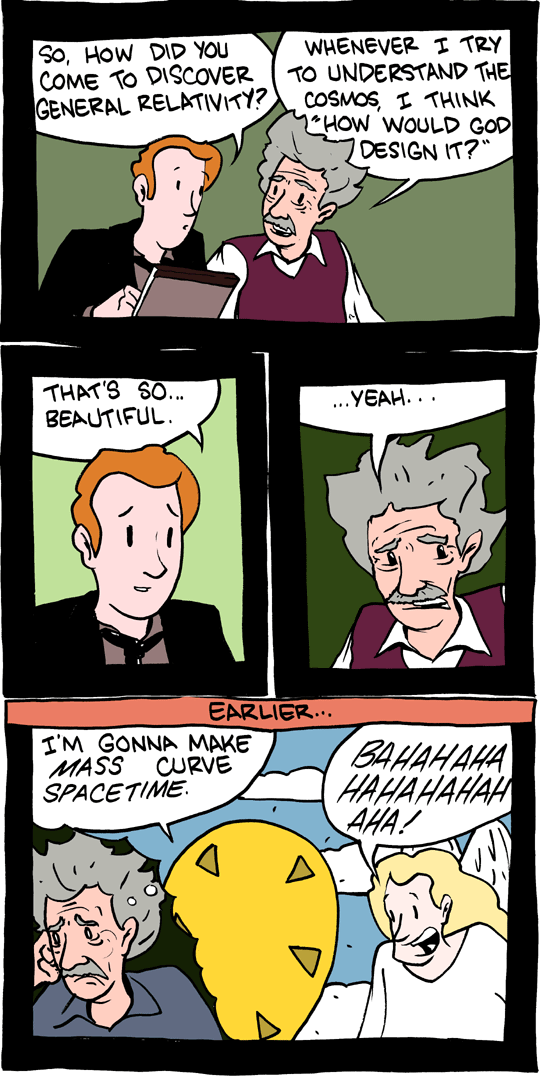
Just heard this from a co-worker, I love it.
A Higgs boson walks into a Catholic church and tries to take Communion. The priest says, "I'm sorry, you haven't been baptized, you'll have to leave." The Higgs boson replies, "But you can't have Mass without me!"


