skip to main |
skip to sidebar
Yes, really.
No, I still do not "believe in belief." But the case studies on non-believing preachers recently published by Dan Dennett and Linda LaScola suggest a way that those who do "believe in belief" might make common ground with the New Atheists, if they would rise to the challenge. (Okay, they won't, but anyway...)
Most of the preachers examined in the paper (I think three out of the five?) could still be classified as "believing in belief", in that they defined God as the "ground of all being" or felt that "there is room for the use of the word ‘God’ in some context", or viewed "God as a kind of poetry." What really struck me was the way that these preachers rationalized the concealment of their more "refined" metaphorical theology from their flocks. That I find far more hypocritical than those preachers who were disillusioned with religion entirely, but kept on the job because they feared for their social or family life, or their financial future.
Telling lies because you will be completely fucked if you don't might be ethically wrong, but it's very human, and anyway I'm not going to condemn anyone for that until I walk in their shoes. If I had to tell lies for a living, and I feared I'd lose my house and maybe even my wife and son if I stopped, you'd better believe I'd go on dropping bullshit from the pulpit. But telling lies because you are trying to protect the tender delusions of people who trust you for answer to the questions that are most important to them? Or because you think the listeners are too dumb or simple to hear the truth? That's never okay.
What also struck me was how much this internal dialog of the preachers in Dennett's and LaScola's case study echoed a dialog that we see over and over again between the New Atheists and the "New Theologians" like Eagleton and Armstrong and their ilk. Our side criticizes literal beliefs and dogmas, the Eaglestrongs of the world respond that we just don't understand their sophisticated theology, and then they plug their ears and refuse to listen when our side points out that that's not how most of the world practices religion, not even in modern supposedly-secular democracies.
With that in mind, I suggest a new strategy: When this tired old conversation crops up again, don't respond by simply dismissing apophatic theology, or whatever clever apologetics the Eaglestrongs are spewing, as something far removed from the actual practice of religion. Instead, challenge them to help get rid of this divide. Challenge Terry Eagleton to arrange to speak to religious groups, and tell them that a literal belief in Jesus' divinity is backwards and infantile, that the true central narrative of Christianity is understanding how "the ultimate signifier of the human condition is the tortured and murdered body of a political criminal", and not any nonsense about original sins being forgiven or any of that crap. Challenge Armstrong to go into Catholic churches, of which she was once a part, and proclaim to the congregation that "religion isn't about believing things", and that instead of telling Africans not to use condoms, they should focus on "translat[ing] these doctrines into...ethical action."
Or to put it more simply: Whenever someone tells an atheist, "But there is a much more advanced theology than that!", our response should be, "Tell someone who cares." Like you know -- people who actually practice religion and go to church. Maybe they'd like to know about your ideas about God and religion, hmmm? And in fact, they might benefit from it quite a bit!
If the Eaglestrongs of the world really truly believed in their poetic/apophatic view of God, they need to do a helluva a lot more to get that message out to believers. And as far as it goes, we can make common cause on that. If there's one thing that Eagleton and Dawkins might agree on, it's that the idea of the virgin birth being a literal event is fucking retarded. Let's get that message out there first, mm'kay?
Edit: In fairness to Armstrong, I think she does do this to a certain extent. Her message seems to be at least as much about reform as it is about apologetics. For instance, in researching for this post, I discovered that she intended to use a $100,000 TED prize "to initiate an international Charter for Compassion – to help restore the Golden Rule as central to religious practice and daily life throughout the world." While I think the Golden Rule stands on its own just fine without the cloud of religion getting in the way, anything that gets the religious to cleave more closely to, you know, actual ethics as opposed to Stone Age dogma has got to be a good thing.
I'm sort of glad I stumbled on that, because it makes me a little less anti-Armstrong. Eagleton's still an irredeemable douche, but it seems Armstrong is already spending a lot of her time working on this "common ground". So credit where credit is due, at least.
XKCD wins again:
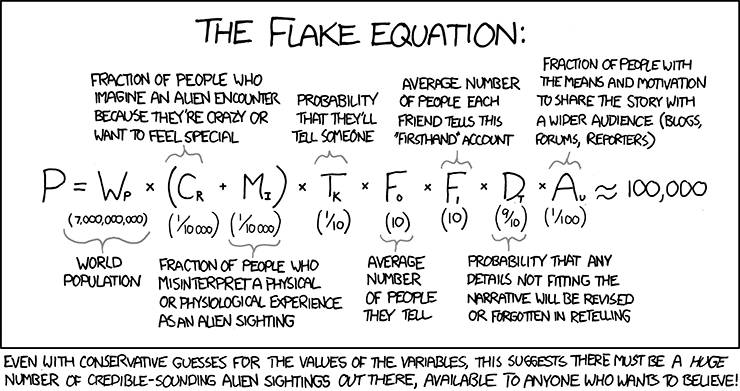
Hilarious but sobering. I would think one could extend this to all sorts of crazy beliefs.
An article in Sunday's New York Times talks about the ongoing challenge of reforming child pornography laws to respond to the phenomenon of "sexting", which is needed to avoid the kinds of travesties where teens get classified as sex offenders for life for sending naked pictures of themselves to a boyfriend or girlfriend.
They quoted a number of law professors from various universities on the topic, the majority of whom agreed that reform is needed and most calling for decriminalization of teen sexting. A typical example comes from Witold Walczak, legal director of the Pennsylvania American Civil Liberties Union, who they quoted as saying, "No one disputes that sexting can have very bad consequences, and no parent wants kids sending out naked images. But if you’ve got thousands of kids engaging in this, are you going to criminalize all of them?" Word.
But two of the law professors that were quoted felt that it should still be classified as felony child pornography -- admittedly, only as a symbolic gesture, though they would rely on the disrection of prosecutors (hardy-har-har) to avoid the disaster of teens being branded for life just for being teens. And who were these two proponents of such draconian laws?
Mary Leary of Catholic University, and Jesse Weins of Dakota Wesleyan University. The only two law professors they interviewed who hailed from religious universities.
Perhaps they think that texting pictures of naked teens should be a privilege reserved only for the clergy...
I happened to be poking around old articles linked to from RichardDawkins.net, and in an article about atheist bus ads in Melbourne, I stumbled across this mostly unrelated but hilarious quote:
The Ahmadiyya community, sparked by a survey that found a quarter of the population regarded Islam as the ''worst religion on earth'', also plans to knock on 3 million doors in a campaign to prove otherwise.
Yeah, good plan, guys. "Our religion has a major public image problem... so in order to fix it, we're going to bother people at home." That's a facepalm if I ever heard one...
Oh boy, the ever-tedious accomodationism debate is flaring up again. I don't know who really fired the first shot (sounds like it was Rosenau, but who can ever tell).1 But really, can't we just lay this one to rest? It's really very simple, and the difference between accomodationists and non-accomodationists can be neatly summed up by critical examination of the following quote from John Wilkins:
...the data is that science and religion coexist nearly all the time – most of those who support scientific views are religious.
And herein lies the heart of the confusion, and I can't believe that folks like Wilkins are still putting their fingers in their ears and saying "Lalalalalala I can't hear you." What us non-accomodationists mean when we say that science and religion are not compatible is not an empirical claim -- it is a philosophical claim. Ultimately there are empirical underpinnings that drive this philosophy, but in the end it is a philosophical claim.
And what is that claim? We are asserting that two epistemologies which consistently yield different results for the same truth claims are inherently incompatible. By definition. That is how we are defining the word "compatible" -- for two epistemologies to be compatible, they must usually yield the same or similar answers to the central questions they seek to answer.
Given that definition, there is of course vast empirical support for the contention that science and religion -- and in this case, I mean "religion" to signify a collection of histories and dogma, rather than a vague notion of spirituality or our good old friend apophatic theology or anything -- are not "compatible". We can see time and time again that they yield different values for the same truth claims. Was Jesus born of a virgin? Science says this is impossible2, Christianity says it is true. Did Mohammed ascend into heaven on the backs of winged horses? Science says no, Islam says yes. Are there beings known as avatars running around on earth appearing human but wielding supernatural powers? Science assumes no without extreme proof, Hinduism assumes it must be true because some dusty old books said so.
The accomodationists typically ignore this line of argumentation altogether, and simply point out that lots of people believe in both science and religion. We know that. I'm so tired of hearing that repeated like it is a refutation of the philosophical claim of incompatibility. It would be like if somebody was trying to argue that music piracy was wrong, and the rebuttal was "but so many people do it!" So what? Yes, we agree, many people simultaneously subscribe to incompatible epistemologies, and the human mind has proved impressively deft at reconciling and dealing with this. There's a reason the idea of doublethink in 1984 was so plausible -- we all already do this, all the time.
That goes for me, too, and Larry Moran, and PZ Myers, and Richard Dawkins, and Josh Rosenau, and every other homo sapiens on this planet. We all engage in a bit of doublethink now and then. Some of us do it more than others, but anybody who denies ever doing it is a liar or a fool. Whether it's rationalizing a minor ethical lapse, convincing yourself that a recent expensive purchase was the right choice, or devotion to a family member even when a cold calculating approach might dictate otherwise... holding contradictory positions is part of being human, and that's okay.
This does not mean that if a particular set of contradictory positions is held by a large number of people that we are forced to stop saying they are contradictory, or else we are being "unscientific" by ignoring the empirical data. That's just inane beyond all comprehension. Yes, absolutely, lots of people are both scientific and religious. This empirical claim is beyond a doubt. The philosophical claim that the two epistemologies are incompatible is a whole separate issue. Care to debate that one, accomodationists? Or do you find the strawman you've constructed too tempting?
1After re-reading Rosenau's original post, I have decided that in one respect he was right on the money: Far too much of the accomodationism debate has centered around who picked the fight. Was it the accomodationists when Mooney et al started saying that Coyne et al were damaging the fight for science education? Or was it Coyne et al when they harshly criticized the NCSE for their stance on science/religion compatibility? I have an opinion about this, but on this point I think Rosenau is right: Who fucking cares. There have been so many shots fired at this point that it is irrelevant who started it. As a result, I regret having commented about that in my original post, and have struck it out.
2Yes, I realize that some people have made the claim that science cannot comment on the truth or falsity of individual claims of supernatural events in the distant past, because there is no way to repeat the experiment or observe it or what have you. Hogwash. By that some logic, science cannot comment on the truth or falsity of the claim that "the sun will rise tomorrow". Nobody has observed that, we can't perform the experiment right now... but I think it's clear that science can say that, in all likelihood, the sun will rise tomorrow, with such a degree of confidence to be essentially true. By the same token, science can properly assert that a virgin homo sapiens cannot become pregnant, with such a degree of confidence that the proposition is essentially false.
sherkat, aka Iranianredneck, mines the GSS to examine the relationship between religious affiliation and support for marijuana legalization. Unsurprising: Christians of all stripes were least likely to support legalization, while the majority of the non-affiliated (57%) are in favor. Surprising: Non-Christians in general were nearly as likely as the non-affiliated to support legalization (54%, more or less within statistical noise I would think). Really super surprising: Jews were far and away the most likely to support legalization out of the groups looked at by sherkat, far more even than the non-affiliated -- a whopping 70%!
Weird. Though I'm sure my wife will get a kick out of it.
(Edit: Suddenly Matisyahu makes so much more sense to me...)
I just came across this via Why Evolution Is True, and there are so many choice quotes in this (very old!) book review that I had to capture them:
There is much else in the literary idiom of nature-philosophy: nothing-buttery, for example, always part of the minor symptomatology of the bogus. 'Love in all its subtleties is nothing more, and nothing less, than the more or less direct tract marked on the heart of the element by the psychical converge of the universe upon itself.' 'Man discovers that he is nothing else than evolution become conscious of itself,' and evolution is 'nothing else than the continual growth of. ... 'psychic' or 'radial' energy'. Again, 'the Christogenesis of St Paul and St John is nothing else and nothing less than the extension ... of that noogenesis in which cosmogenesis ... culminates'.
Ha ha, "nothing-buttery," I love it. I'm going to have to try to remember that one. I perhaps have fallen into this same rhetorical trap myself at times, but Medawar is right: It makes the speaker sound presumptuous and ridiculous.
...yet he uses in metaphor words like energy, tension, force, impetus and dimension as if they retained the weight and thrust of their specific scientific usages.
Ah, never have I seen such a damning critique of pseudoscience put so succinctly. It seems Medawar has described a special class of deepity, especially favored by New Age-y types. If I say, "I really feel negative energy coming from you," the metaphorical meaning is true-but-trivial (you are making me feel upset), while the literal meaning is earth-shattering-but-false (you are emitting a very real heretofore-undescribed physical force which I am able to detect).
Just as compulsory primary education created a market catered for by cheap dailies and weeklies, so the spread of secondary and latterly tertiary education has created a large population of people, often with well-developed literary and scholarly tastes, who have been educated far beyond their capacity to undertake analytical thought.
A bit elitist, perhaps, but so very accurate. And frustrating.


